
CCTV OPERATIONS · 1 NOVEMBER 2026
CCTV camera health and tamper monitoring: an acceptance worksheet
A camera can remain online while its view is blocked, blurred, redirected or too dark to be useful. This worksheet proves that image-health, communication, recording and infrastructure faults reach the right operator with enough context to act.
Visual reference photographs

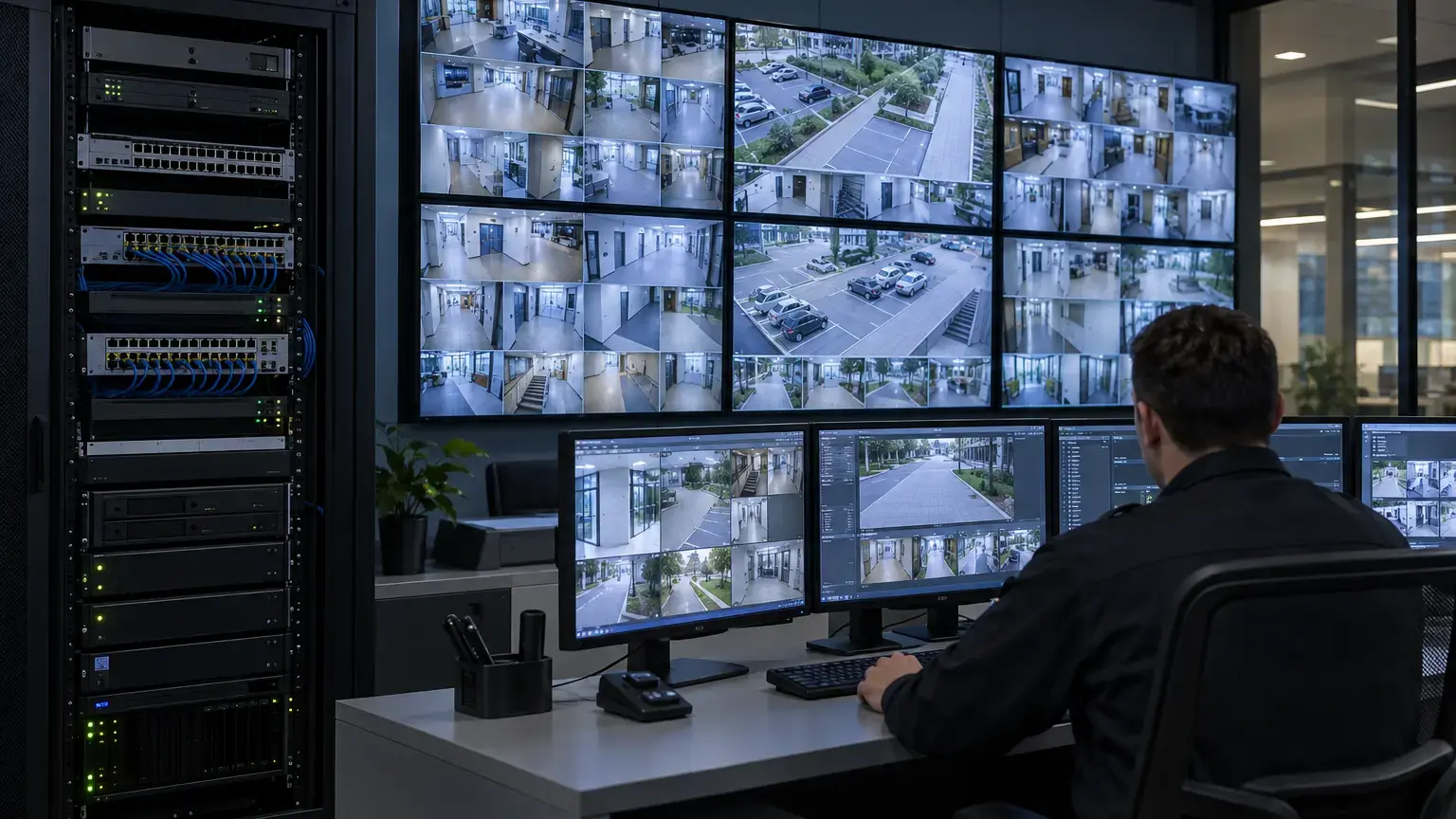
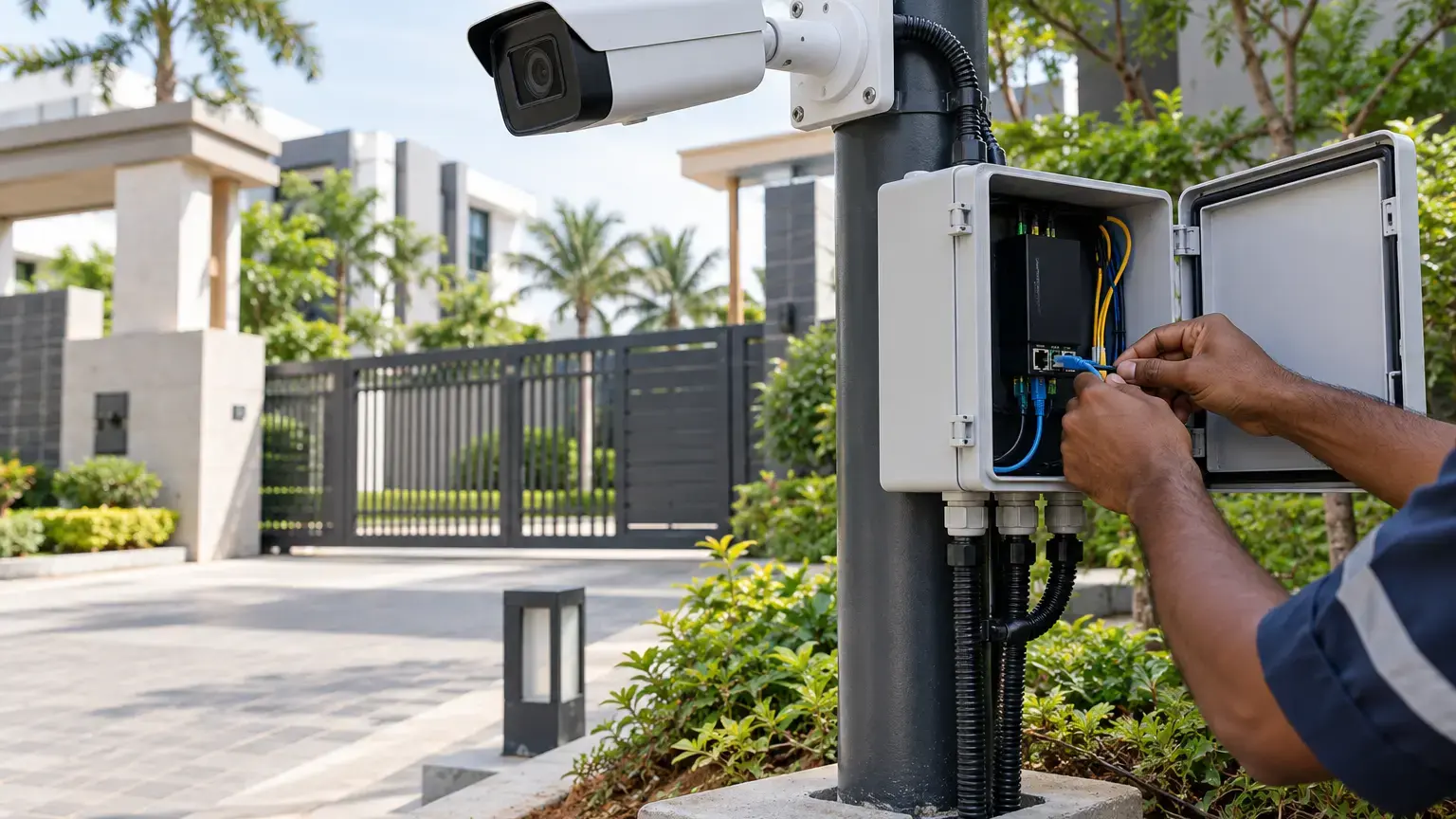
1. Build a health-event matrix
| Layer | Failure examples | Required evidence |
|---|---|---|
| Image | Blocked, redirected, blurred, underexposed, fogged or defocused | Camera event, snapshot, start and clear time |
| Camera | Restart, temperature, shock, storage or analytics failure | Device log and VMS event |
| Network | Link down, PoE loss, packet loss, duplicate address or fiber fault | Switch, NMS and VMS correlation |
| Recording | Recording stopped, feed overflow, database or storage unavailable | Timeline gap and recorder alarm |
| Operations | Alarm not routed, ignored, duplicated or auto-closed | Acknowledgement, escalation and closure record |
Milestone distinguishes communication errors at hardware and device level and also exposes recording stopped, feed overflow and storage-unavailable events. A camera can therefore communicate while its recording path fails. Keep these conditions separate in the alarm design.
2. Record the approved reference state
For every camera, retain an approved day and night reference image, camera ID, position, lens setting, intended purpose, firmware, analytics version and expected scene. Mark stable edges and objects that help redirection or blockage detection. Axis notes that scenes without distinct features can be unsuitable for image-health analytics.
Document privacy masks, overlays, digital stabilization, corridor rotation, PTZ presets, WDR, day-night mode and external lighting. These settings can change what the analytic learns. Relearning after a maintenance change must be controlled, because learning an already blocked or redirected scene can normalize the fault.
3. Tune sensitivity and validation time together
High sensitivity can detect smaller changes but increase nuisance alarms. A validation period requires the fault to persist before the event is raised. Axis gives a parked delivery truck as an example where a longer period can suppress a temporary obstruction. The correct delay depends on camera purpose: a gate camera may need faster response than a general parking overview.
Detection start timestamp to alarm timestamp
Clear time
Restoration timestamp to clear-event timestamp
Nuisance ratio
Non-actionable alarms ÷ total alarms during the observation period × 100
Do not tune only to minimize alarm count. Record missed events, nuisance events and detection latency for each fault class. A long validation time can hide a short but important obstruction.
4. Test blocked-view detection
Use a removable, non-damaging test target. Cover increasing portions of the view, including the center, edge and region containing the most distinctive features. Test opaque cover, low-contrast cover and a near-lens obstruction. Never spray or contaminate a production lens.
Record the blocked percentage at trigger, validation delay, alarm payload, linked snapshot and clear behavior. Axis warns that a vehicle can create the same blocked event as intentional tampering, so the operator needs context and a verification view.
5. Test redirection and physical movement
Capture the approved position, then move a test camera by small controlled increments within its safe mount limits or use an authorized simulator. Measure the smallest change that triggers. Verify the event remains active while the view is wrong and clears only after restoration or an approved relearn.
For PTZ cameras, distinguish manual movement, presets, guard tours and physical displacement. Axis Image Health Analytics suspends analysis during PTZ motion and requires stabilization and relearning time. Test each supported preset and dwell time instead of assuming a fixed-camera workflow.
6. Test blur, defocus and underexposure
Use a reversible optical filter or controlled focus change according to manufacturer procedure. Review whether the alarm triggers before the image becomes operationally useless. At night, test IR mode, external lighting failure and strong backlight. Axis notes that lighting changes and shadows can alter scene appearance, while Hanwha provides separate defocus, fog and tampering events on supported devices.
Alarm timestamp - timestamp when the agreed image task first fails
A positive gap means the system remained unusable before alerting. Define the task with a test target, such as recognizing a known person or reading designed detail, rather than subjective sharpness.
7. Test communication without hiding recording faults
- Disconnect the camera network link during an approved test window.
- Record VMS communication-error time and NMS link-down time.
- Restore the link and verify communication-started behavior.
- Confirm recording resumes and measure the central timeline gap.
- If edge storage exists, verify retrieval and timeline reconciliation.
- Stop recording by an approved configuration or service test while leaving the camera reachable.
- Verify recording-stopped or equivalent alarms are distinct from communication loss.
- Simulate recorder storage or feed pressure only in a controlled test environment.
Alarm timestamp - physical fault timestamp
Unrecovered recording gap
Last frame before fault to first continuous frame after recovery, minus successfully backfilled footage
8. Correlate PoE, network and environmental evidence
A camera-offline alarm identifies the symptom, not the cause. Correlate it with switch link state, PoE allocation, power-supply alarms, UPS state, optical uplink status, interface errors and enclosure temperature. If many cameras fail together, the alarm system should group the likely shared infrastructure fault instead of generating an unmanageable wall of isolated tickets.
Where supported, test shock, temperature and local storage alarms. Map each event to maintenance ownership: security operator, facilities electrical team, network team, CCTV integrator or site management.
9. Prove alarm routing and operator action
Trigger every accepted event through the production path. Confirm it reaches the intended VMS alarm queue, email, mobile notification, NMS or ticket system. Verify camera name, location, event class, severity, timestamp, snapshot and runbook link. Do not send credentials or expose unrestricted camera URLs in notifications.
Test acknowledgement, assignment, escalation after no response, duplicate suppression and closure. A clear event should not erase the incident record. For critical cameras, confirm the fallback recipient when the primary operator is unavailable.
Notification receipt timestamp - physical fault timestamp
Operator response time
Acknowledgement timestamp - notification receipt timestamp
Repair time
Verified restoration timestamp - incident creation timestamp
10. Control false alarms and relearning
Run an observation period through sunrise, sunset, rain, cleaning, deliveries, crowds, headlights, insects and normal PTZ activity. Classify every event as actionable, nuisance, duplicate or missed. Tune one parameter at a time and preserve the before-and-after setting.
Axis documents that a blocked or redirected scene persisting for a long period may be relearned. Treat unresolved image-health alarms as time-critical. Firmware updates, privacy-mask changes, lens adjustment, camera replacement, view changes and analytics upgrades must trigger regression testing and a new reference image.
11. Acceptance checklist
- Every camera has approved day and night reference images.
- Image, device, network, recording and operational events are separated.
- Supported event names are verified for the exact model and firmware.
- Scene suitability and distinctive features are recorded.
- Sensitivity and validation periods are approved by camera purpose.
- Blocked-view tests cover multiple positions and obstruction types.
- Redirect thresholds and restoration behavior are measured.
- Blur, defocus and underexposure tests use reversible methods.
- PTZ presets, tours, stabilization and relearning are tested.
- Communication loss and restoration events are verified.
- Recording-stopped alarms work while the camera remains reachable.
- Timeline gaps and edge-storage recovery are measured.
- PoE, switch, uplink and environmental evidence is correlated.
- Alarm payload identifies camera, site, class and severity.
- Acknowledgement, escalation, duplicate suppression and closure work.
- Nuisance and missed-event results are documented.
- Configuration, reference images, logs and runbooks are handed over.
- Maintenance and upgrade changes trigger controlled regression testing.
12. Primary technical references
- Axis: AXIS Image Health Analytics
- Axis: Tampering Detection configuration
- Milestone XProtect 2026 R1: Events overview
- Milestone XProtect 2026 R1: System health monitoring
- Hanwha Vision: Camera event settings
Commissioning CCTV health monitoring?
Share the camera schedule, VMS, event capabilities, critical views and escalation requirements. Cyber FTTH Mart can help structure reversible fault tests, alarm routing and handover evidence.
Discuss CCTV health acceptance ↗