

NETWORK RACK RESILIENCE · 8 OCTOBER 2026
Network rack UPS runtime and shutdown: a commissioning worksheet
A UPS label showing a VA rating does not prove that a rack will stay available for the required time. Commissioning must connect the real load, battery condition, runtime target, alarm path, shutdown sequence and recovery plan. This worksheet helps facilities teams, builders and network owners record that evidence before handover.
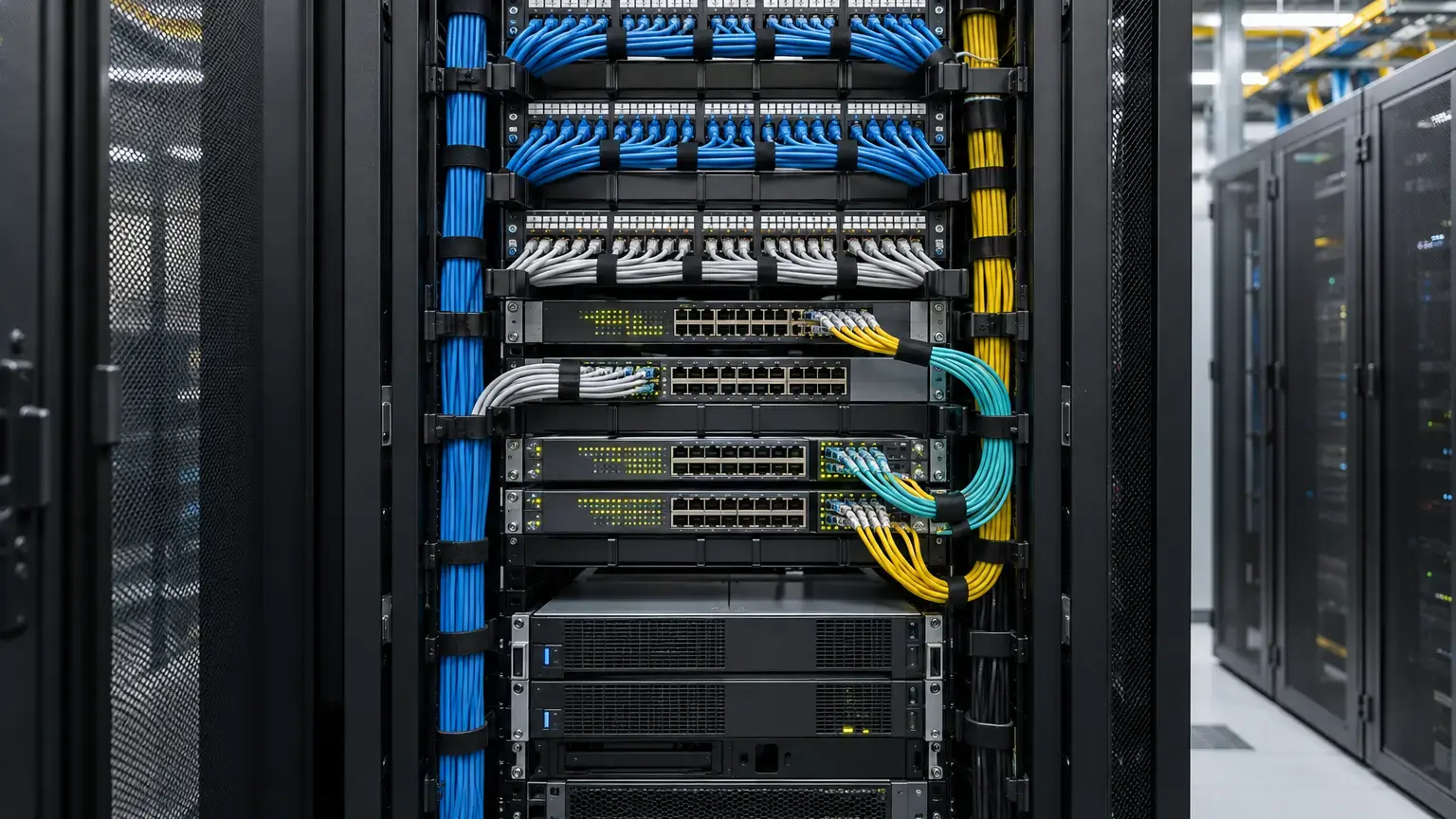
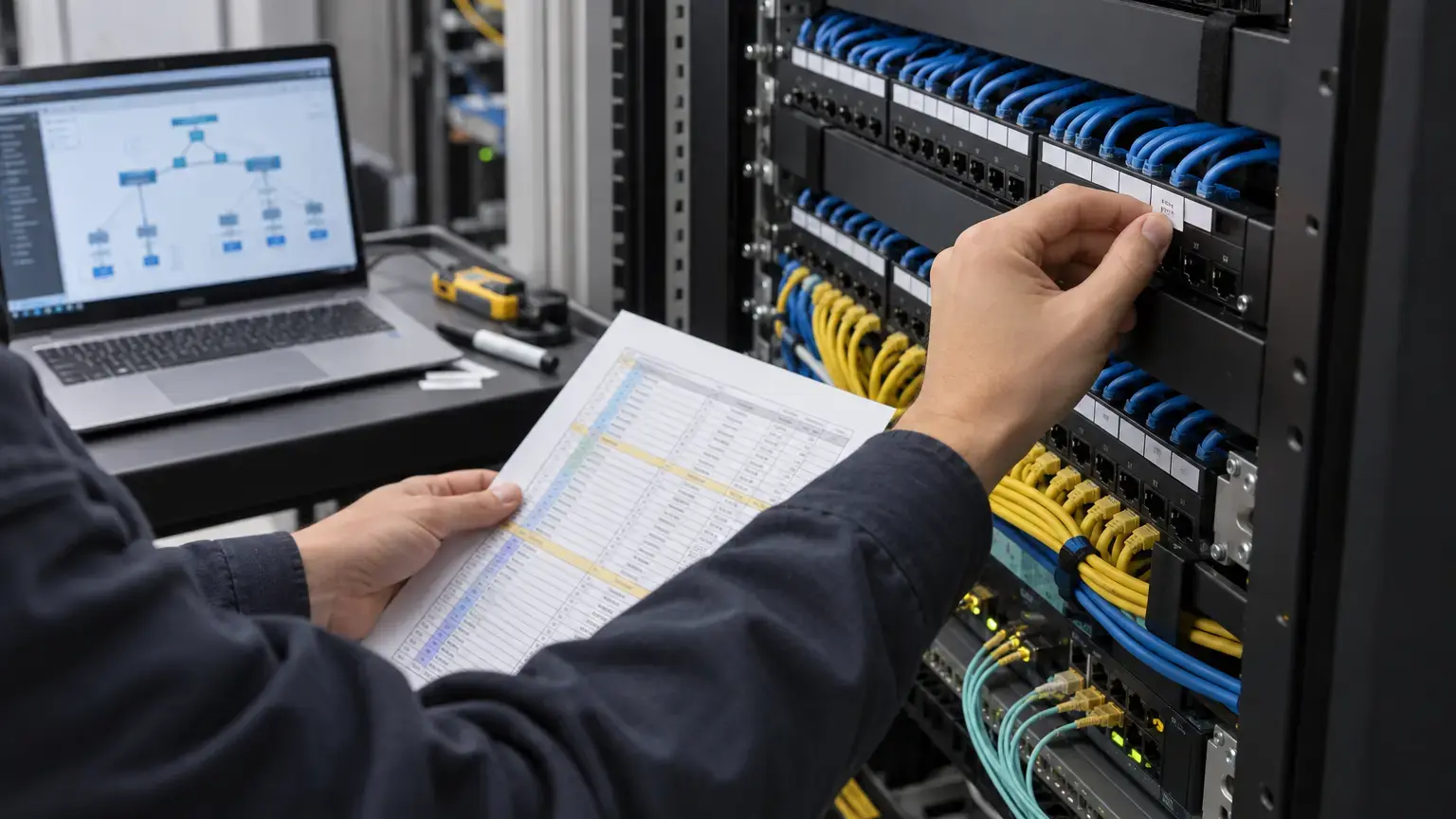
Visual reference photographs

Define the service outcome before selecting runtime
Start with the business requirement. A security rack may need cameras, access controllers and network uplinks to remain available through short interruptions. A server rack may instead need enough time for an orderly shutdown. A small ISP or apartment network may require the core router and optical equipment to outlast branch switches. These are different outcomes and should not be reduced to one arbitrary runtime number.
Service requirement row: rack ID · protected services · acceptable interruption · target runtime · shutdown required · restart method · generator interaction · service owner · witness.
Build the load inventory from the installed rack
List every device connected to the UPS, including switches, routers, firewalls, NVRs, servers, storage, optical terminals, controllers, monitors and auxiliary power supplies. Record the measured operating load where approved, the equipment nameplate information, power-supply redundancy and whether any PoE switch load changes when cameras or access points are active.
Do not size from the sum of switch nameplates alone. The commissioning record should distinguish present measured load, credible maximum operating load and future reserved capacity. APC notes that UPS runtime decreases as load increases, and that battery age, temperature and operating conditions also affect available backup time. See the official Schneider Electric battery-life and runtime guidance.
Record the complete power path
Draw the path from utility or generator supply through the input protection, UPS, maintenance bypass where provided, rack PDU, outlet and equipment power supply. Identify any device that bypasses the UPS, any single power lead shared by otherwise redundant equipment, and any unmanaged extension that could be moved without updating the record.
For equipment with dual power supplies, record which supply is connected to which source. Two cords connected to the same UPS or PDU do not provide source diversity. If a generator is part of the design, witness the transfer behaviour and confirm that the UPS remains within its supported input conditions using the selected manufacturer's instructions.
Use manufacturer runtime data as a starting point
Runtime estimates are model-specific. Use the selected UPS manufacturer's published curve or calculator for the exact UPS, battery pack and load, then compare it with the installed display or management reading. Record the assumptions, battery quantity, battery age and firmware or management reference used for the estimate.
The estimate is not the final acceptance result. A controlled on-battery test should follow the agreed method without placing an occupied facility at unacceptable risk. Avoid unnecessary full discharges: Schneider Electric warns that excessive runtime calibrations and deep discharge can shorten battery life. Test frequency and depth should follow the product documentation and maintenance policy.
Protect battery life through placement and records
Record rack-room temperature, ventilation, dust exposure, clearance, battery installation date, replacement-battery reference and the UPS self-test status. Schneider Electric states that battery service life is affected by ambient temperature, input power quality, placement, load and application. Its single-phase UPS lifecycle guidance recommends assessing those conditions rather than using age alone.
Do not invent a universal replacement date. Use the selected manufacturer's supported battery type, alarms, test results and maintenance instructions. Record who is responsible for periodic checks and how an end-of-life or replace-battery alarm is escalated.
Commission alarms and graceful shutdown separately
A local buzzer is not enough when the rack is unattended. Test the agreed alarm path for loss of utility, low battery, overload, replace-battery condition, internal fault and loss of management communication. Record the recipient, delivery method, timestamp and acknowledgement process.
Where servers, storage or virtual systems require graceful shutdown, document the trigger, delay, operating-system shutdown allowance, dependency order and UPS turn-off action. APC describes PowerChute Network Shutdown as providing network-based, unattended graceful shutdown for supported physical and virtual systems. The official UPS management software guide and shutdown-parameter guidance explain that these timings must be coordinated.
Shutdown sequence row: trigger · confirmation delay · dependent systems · shutdown command · operating-system allowance · UPS delay · minimum remaining runtime · restart behaviour · test result · log filename.
Witness failure and recovery without creating a new outage
Agree the test window, safety controls and rollback plan before removing utility input. Confirm that the UPS transfers to battery, the critical devices remain powered, alarms arrive, the displayed load and runtime are recorded, and recovery follows the documented sequence when input returns. Where a full-duration test is unsafe, record the approved partial test and the evidence used to support the remaining runtime assessment.
After recovery, confirm that switches, routers, recorders, controllers and management systems return to their intended state. Check time synchronization, recording continuity, PoE endpoint recovery and any device that requires manual intervention. A successful UPS test is incomplete if the rack has power but the service has not recovered.
UPS commissioning worksheet
- The protected services, target runtime and permitted shutdown outcome are approved.
- The installed UPS model, rating, serial number, firmware and battery configuration are recorded.
- Every connected load is identified and mapped to a UPS or PDU outlet.
- Present load, credible maximum load and reserved capacity are distinguished.
- PoE demand and other variable loads are included in the assessment.
- The utility, generator, bypass, UPS, PDU and equipment power path is documented.
- Dual power supplies are traced to their actual sources.
- The manufacturer runtime estimate and its assumptions are retained.
- Battery installation date, self-test result, alarms and replacement reference are recorded.
- Rack temperature, ventilation and clearance observations are documented.
- On-battery transfer is witnessed under an approved test plan.
- Runtime or controlled discharge evidence is recorded without unnecessary deep discharge.
- Utility-failure, low-battery, overload and fault alarm paths are tested.
- Graceful shutdown timings exceed the measured shutdown requirement with an agreed margin.
- Recovery after input restoration is witnessed for network, CCTV, access and server services in scope.
- Exceptions, responsible owners and closure dates are recorded.
- The maintenance owner, check interval and battery-replacement decision process are handed over.
Related reading: use the network rack labeling and documentation worksheet for power-source and equipment records, and the switch redundancy and loop-prevention worksheet for controlled failure testing. For project delivery, see data-centre and server-room network infrastructure.
Planning a rack, server-room or network-room handover?
Share the equipment schedule, measured load, runtime requirement, UPS model, shutdown dependencies and generator arrangement. We can structure the rack power, networking and acceptance records around the actual project scope.
Discuss the infrastructure project ↗